The BKIN is a 120-credit degree that combines foundational Kinesiology courses with upper-level study in your chosen area of interest. You’ll build your Kinesiology foundation in Years 1 and 2, then deepen your knowledge through option-specific coursework and electives in Years 3 and 4.
Every student’s journey through the BKIN program will look a little different. Your course choices may depend on your interests, academic goals, transfer credits, course availability, and plans for graduate or professional studies.
Your Degree At A Glance
Years 1 and 2 focus on developing core knowledge and skills, while Years 3 and 4 give you more flexibility to explore your interests through program options, upper-level Kinesiology courses, and experiential learning. Below, you’ll find an overview of what to expect in each year and how the different degree requirements fit together.
Year 1: Building Your Academic Foundation
Develop essential skills in anatomy, physiology, and movement sciences while exploring the full breadth of kinesiology. Begin to understand how humans move, perform, and interact with their environment, and build the foundational knowledge needed for more advanced study. At the same time, adapt to university-level learning by developing critical thinking, academic writing, and study strategies that will support success throughout your degree.
Core KIN Courses
| KIN 110 | Human Anatomy | 3 credits |
| KIN 120 | Health and Exercise Management | 3 credits |
| KIN 131 | System Physiology I | 3 credits |
| KIN 132 | Systems Physiology II | 3 credits |
| KIN 150 | Sports and Exercise Psychology | 3 credits |
| KIN 160 | Leisure and Sport in Society | 3 credits |
| WRDS 150 | Writing and Research in the Disciplines | 3 credits |
General Electives
| Elective* | Any course, any level | 3 credits |
| Elective* | Any course, any level | 3 credits |
| Elective* | Any course, any level | 3 credits |
* KIN 140 is a recommended elective for students aspiring to pursue specific upper-level KIN courses.
Year 2: Deepening Your Kinesiology Knowledge
Promotion to Year 2 standing is based on the successful completion of 24 credits.
Strengthen your understanding of human movement, research methods, and health sciences through core KIN courses that build on your first-year foundation. Engage with more complex concepts in physiology, biomechanics, and motor behaviour, and develop critical analytical and research skills.
Core KIN Courses
| KIN 205 | Research Methods in Kinesiology | 3 credits |
| KIN 206 | Statistics in Kinesiology | 3 credits |
| KIN 211 | Human Motor Behaviour | 3 credits |
| KIN 216 | Biomechanics I | 3 credits |
| KIN 232 | Nutrition, Health, and Physical Activity | 3 credits |
| KIN 235 | Exercise Physiology | 3 credits |
| KIN 262 | Health Policy and Society | 3 credits |
General Electives
| Elective | Any course, any level | 3 credits |
| Elective | Any course, any level | 3 credits |
| Elective | Any course, any level | 3 credits |
You will have the opportunity to select one of three program options when Year 2 registration opens: either Neuromechanical and Physiological Sciences (NPSC), Social and Behavioural Sciences (SBSC), or Multidisciplinary Science (MDSC).
Year 3: Advancing in Your Field
Promotion to Year 3 standing is based on the successful completion of 48 credits.
Focus your degree by selecting one of the three BKIN program options – Neuromechanical and Physiological Sciences (NPSC), Social and Behavioural Sciences (SBSC), or Multidisciplinary Science (MDSC) – and begin diving into specialized courses.
In your third year, you should aim to plan a balanced schedule that includes a mix of stream-specific courses, upper-level KIN electives (indicated as ‘UL’ below), as well as general electives (KIN or non-KIN) balanced across both terms. The following course sequence provides a template that students who aspire to graduate in four years can use to structure their third year.
Stream-Specific Courses
| UL KIN | Stream-specific | 3 credits |
| UL KIN | Stream-specific | 3 credits |
| UL KIN | Stream-specific | 3 credits |
KIN Electives
| UL KIN | Non-Stream Specific | 3 credits |
| UL KIN | Non-Stream Specific | 3 credits |
| UL KIN | Non-Stream Specific | 3 credits |
*UL KIN electives can include Advanced Seminars, Work-Integrated Learning, Directed Studies (KIN 490) or Research (KIN 492)
General Electives
| Elective* | Any course, any level | 3 credits |
| Elective* | Any course, any level | 3 credits |
| Elective* | Any course, any level | 3 credits |
| Elective* | Any course, any level | 3 credits |
*Minimum of 48 credits at the upper-level required throughout Year 3 and Year 4
Year 4: Putting Knowledge Into Practice
Promotion to Year 4 standing is based on the successful completion of 78 credits.
Take your learning to the next level through upper-level electives, advanced seminars, Work-Integrated Learning, and undergraduate research. Apply your knowledge in real-world contexts as you prepare for your transition into graduate studies, professional programs, or other post-BKIN opportunities.
Stream-Specific Courses
| UL KIN | Stream-specific | 3 credits |
| UL KIN | Stream-specific | 3 credits |
| UL KIN | Stream-specific | 3 credits |
| UL KIN | Stream-specific | 3 credits |
KIN Electives
| UL KIN | Non-Stream Specific | 3 credits |
| UL KIN | Non-Stream Specific | 3 credits |
*UL KIN electives can include Advanced Seminars, Work-Integrated Learning, Directed Studies (KIN 490) or Research (KIN 492)
General Electives
| Elective* | Any course, any level | 3 credits |
| Elective* | Any course, any level | 3 credits |
| Elective* | Any course, any level | 3 credits |
| Elective* | Any course, any level | 3 credits |
*Minimum of 48 credits at the upper-level required throughout Year 3 and Year 4
BKIN Program Options
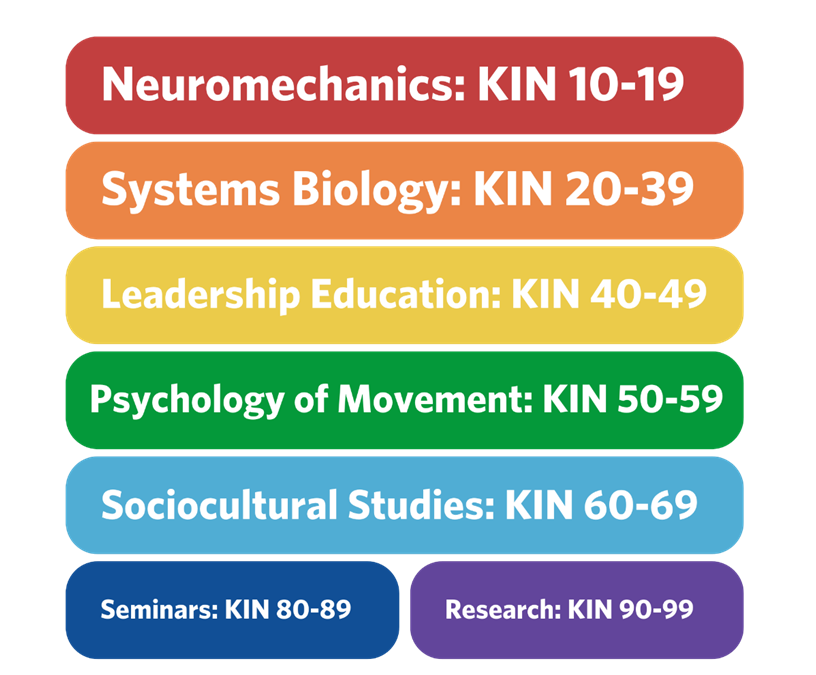
Program options allow you to focus your 3rd- and 4th-year studies on specific areas of interest. Each of the following 3 program options brings together courses around a common theme, helping you develop deeper knowledge and skills in an area that aligns with your academic interests and future goals.
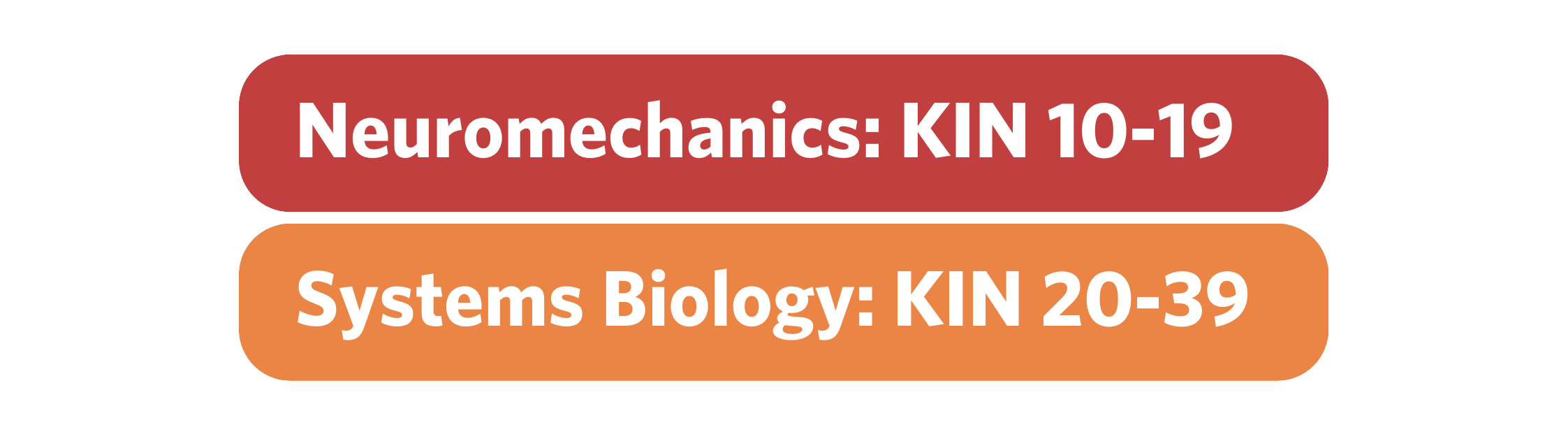
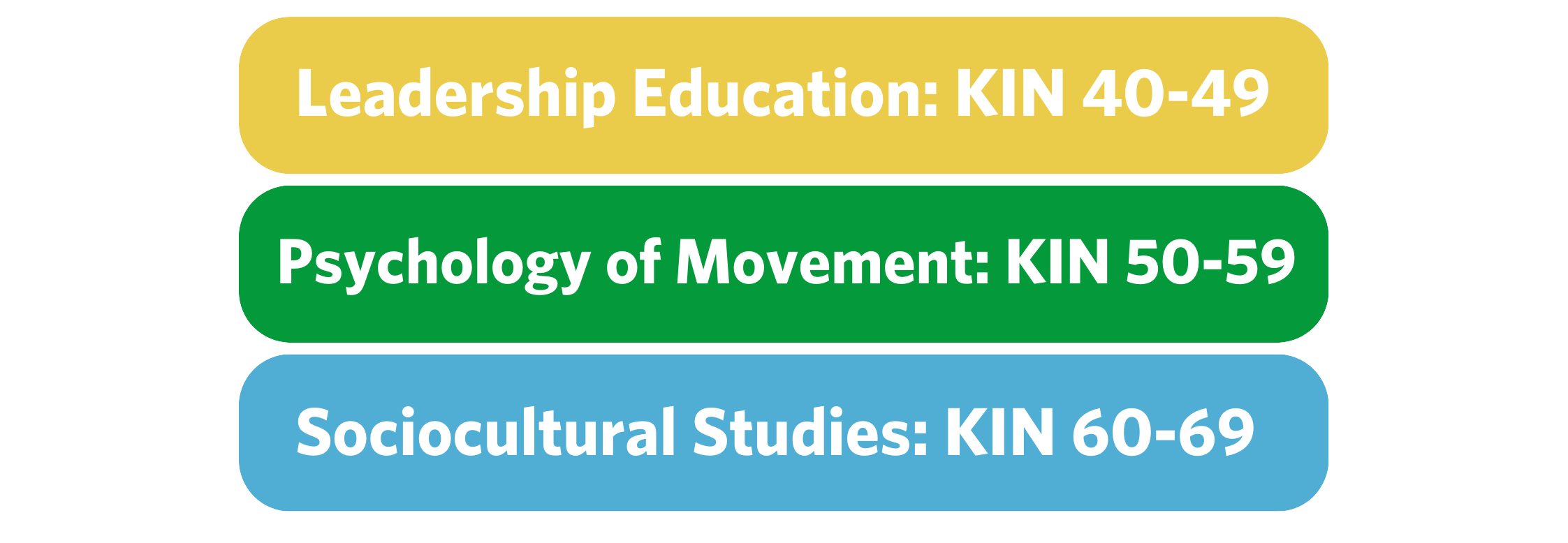
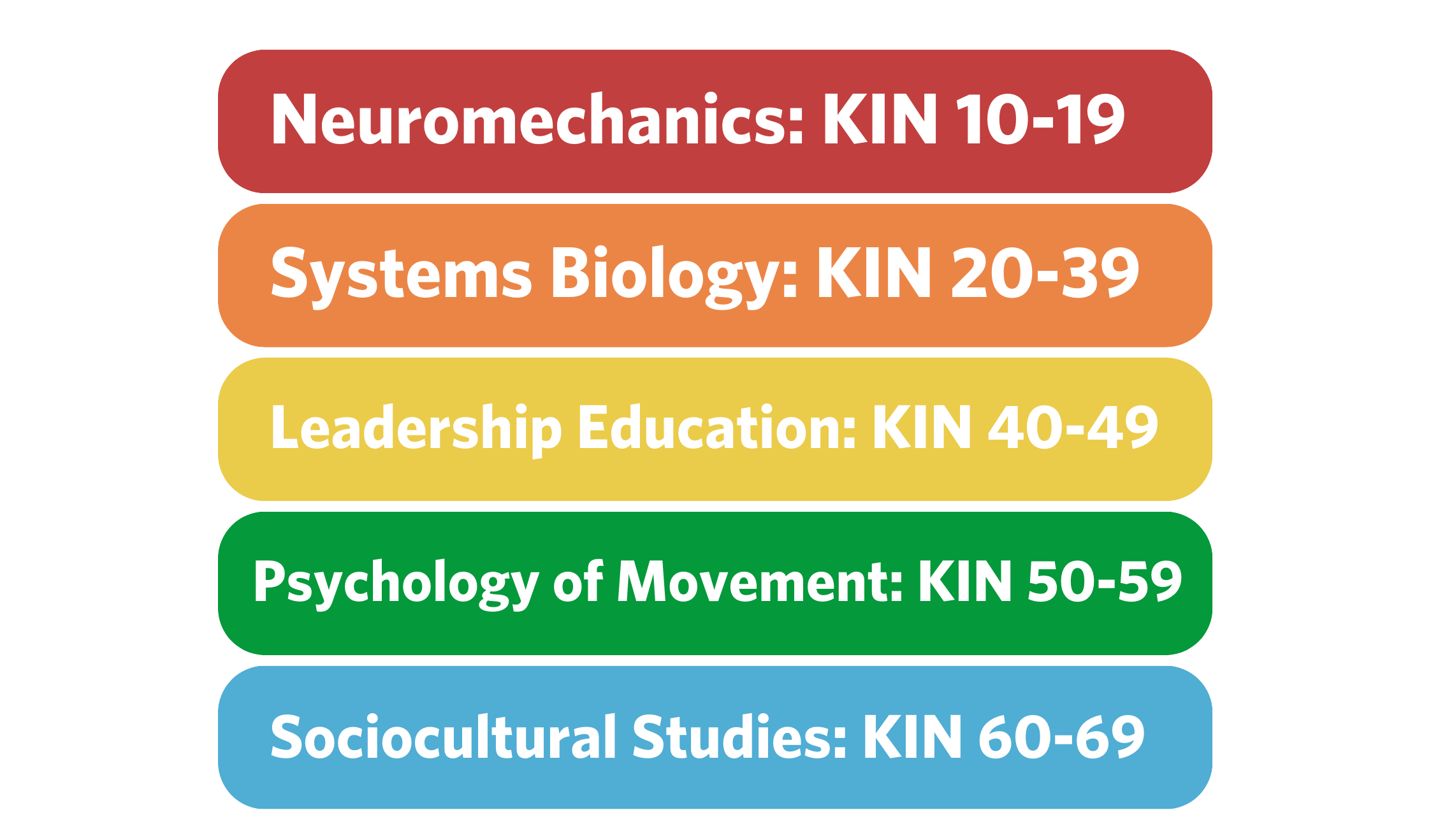
You must complete at least 48 upper-level credits, including 21 credits of option-specific coursework across five thematic areas. 15 additional upper-level KIN electives are also required, which may include courses from any thematic area or approved experiential learning opportunities such as Advanced Seminars, Work-Integrated Learning, Directed Studies, or Undergraduate Research Experience courses.
See the Course Outlines page for specific courses within each thematic area.
Option in Neuromechanical and Physiological Sciences
The NPSC stream focuses on understanding the complexities of human anatomy and the processes that control motion. This exploration covers physiological, neural, mechanical, and behavioral elements, highlighting how they interact. Moreover, the curriculum examines how factors such as physical activity, aging, and disease affect these elements. To fulfill the NPSC option, students must complete 21 credits of upper-level KIN courses in the following thematic areas:
Option in Social and Behavioural Sciences
The SBSC stream emphasizes investigating the psychosocial, historical, and cultural aspects of sport, physical activity, and health behavior. This analysis extends to comprehending their effects on both individuals and societies. To complete the SBSC option, students must complete 21 credits of upper-level KIN courses in the following thematic areas:
Option in Multidisciplinary Science
The MDSC stream offers flexibility in designing your own program of study through course selections from each of the 5 thematic areas. This approach enables the creation of a comprehensive, cross-disciplinary curriculum. To complete the MDSC option, students must complete a combination of 21 credits of upper-level KIN courses: including 2 courses in 3 out of the 5 themes offered, as well as 1 course from either of the remaining 2 lists:
Academic Progress Reports
Academic Progress Reports (APRs) in Workday help you track your BKIN degree requirements and progress toward graduation. All BKIN students are responsible for understanding and regularly reviewing their APR. Check your APR regularly to see what you’ve completed, what’s in progress, and what requirements remain. If you’re unsure how to interpret your APR or a requirement, KIN Advising is here to help.
Once you have declared your program option, your APR becomes a powerful tool to help you track your NPSC, SBSC or MDSC degree requirements. Follow along for a useful guide on how to read your APR effectively.
Your APR will look different in your first year before you’ve declared your stream. Use this tutorial to give you helpful tips on how to find your 100-level core KIN courses, and how to interpret your electives.